

2026 Top U.S. Interior Design Trends—and How Tatami Mats Fit in
INDEX
- Why 2026 U.S. Homes Are Turning Toward Calm, Warmth, and ‘Real Life’ Design
- 2026 Trend Pairing #1: Warm Minimalism (and ‘Cozymaxxing’) + Tatami
- 2026 Trend Pairing #2: Earthy Neutrals, Rich Woods, and Time-Worn Character + Tatami
- 2026 Trend Pairing #3: Wellness-First Interiors + Tatami (Meditation, Stretching, Reading)
- 2026 Trend Pairing #4: Slow Design, Craft, and Materials With a Story + Tatami
- U.S. vs Japan: The Cultural Difference That Makes Tatami So Versatile
- Choosing a Tatami Mat for a Modern U.S. Home
- Summary: Your 2026 tatami-ready trend checklist
Why 2026 U.S. Homes Are Turning Toward Calm, Warmth, and ‘Real Life’ Design
The 2026 mood: warmth, longevity, and well-being
In the U.S., 2026 interior design is less about chasing a brand-new “look,” and more about building a home that feels calming, personal, and durable. That shift is great news for natural, tactile materials—especially tatami, which can instantly make a space feel grounded without needing a full remodel. Houzz positions 2026 homes as spaces driven by intention and ease, reflecting a shift toward warmth and well-being over newness.
Designing for real living: lived-in interiors (not showroom-perfect)
Another 2026 signal is permission to stop decorating for the camera. Vogue points to lived-in, time-worn interiors and the idea that your room should reflect how you actually live—books, textiles, favorite objects, and all.
Tatami fits this perfectly because it’s functional first (a true floor surface), yet also visually calming. It helps a room feel “finished” without feeling staged.
Layouts that adapt: multigenerational and accessibility-minded design
The U.S. is also leaning into layouts that work across life stages—single-level living, wider walkways, and practical storage. This matters for tatami styling because modular, unit-style tatami lets you create a soft, defined zone (reading, stretching, play) while keeping paths and furniture placement practical.
2026 Trend Pairing #1: Warm Minimalism (and ‘Cozymaxxing’) + Tatami
How tatami supports texture, comfort, and a grounded feel
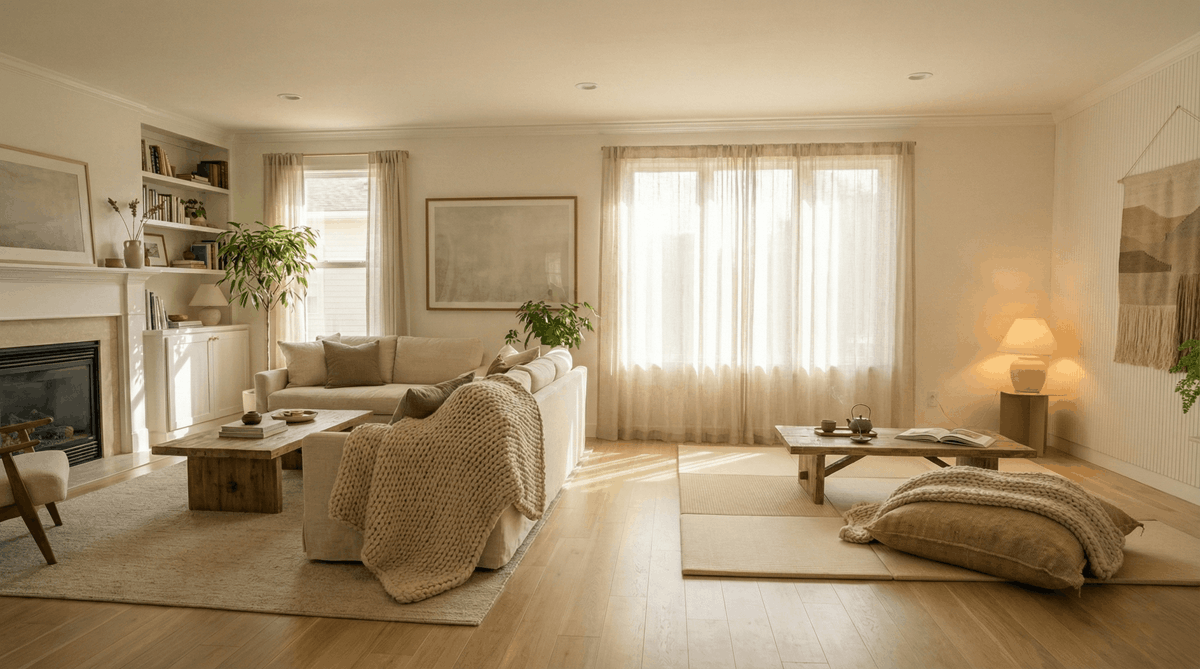
Warm minimalism is a softer take on minimalism—clean and simple, but never cold. It favors fewer items with richer textures: linen, wool, wood grain, ceramics, and soft, layered lighting. “Cozymaxxing,” as described in U.S. lifestyle coverage, also focuses on how a room feels—tactile, calming, and intentionally layered.
Tatami naturally supports this because it adds an organic texture underfoot and encourages you to slow down—sit, stretch, read, or sip tea—without turning your home into a “theme.”
A quick formula: the 5-senses cozy corner with unit tatami
Try this simple setup:
- Sight: keep the palette quiet (sand, warm beige, olive, soft brown).
- Touch: add one textured throw + one natural-fiber cushion.
- Sound: soften echo with curtains or a textile wall hanging.
- Scent: subtle incense or a cedar sachet (optional, but very “Zen”).
- Light: warm lamps over harsh overheads (especially at night).
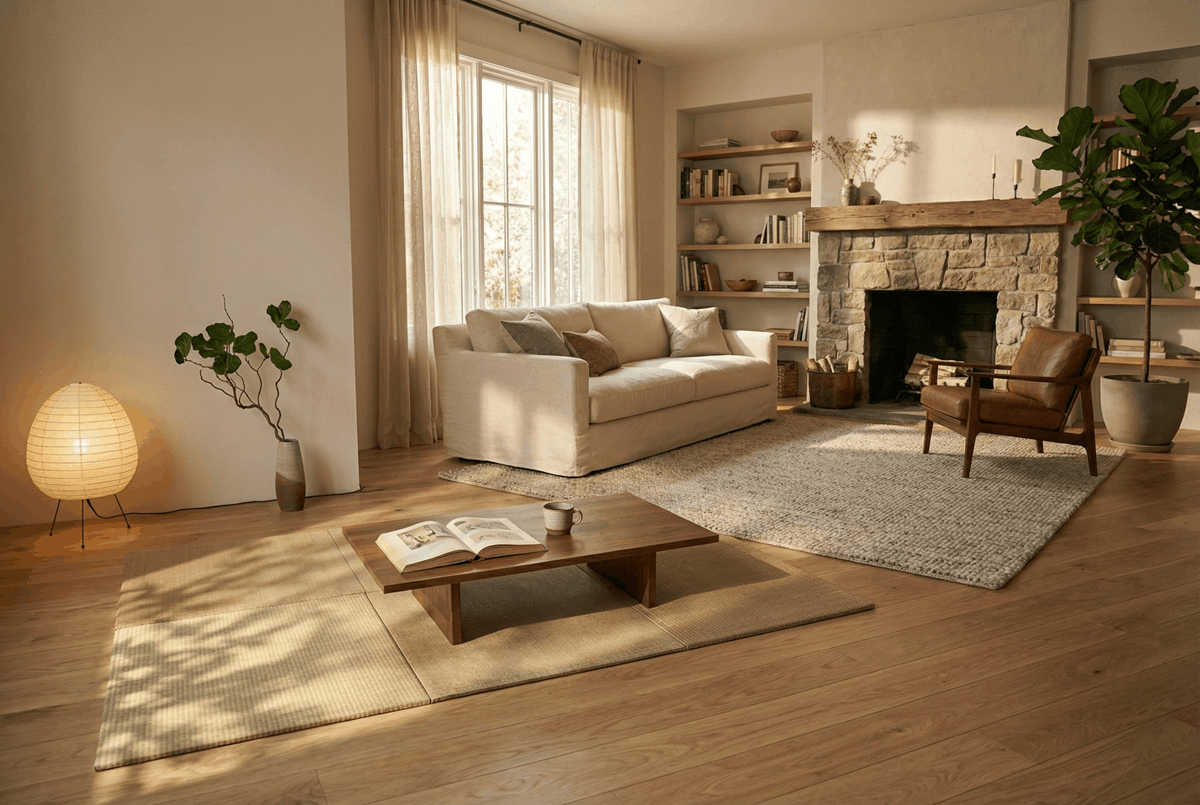
Place unit tatami squares as the “base layer” for the corner—then add a low table or floor cushion. The result is a trend-forward 2026 space that still feels timeless.
2026 Trend Pairing #2: Earthy Neutrals, Rich Woods, and Time-Worn Character + Tatami
Color pairing ideas: browns, olives, sand, and muted greens
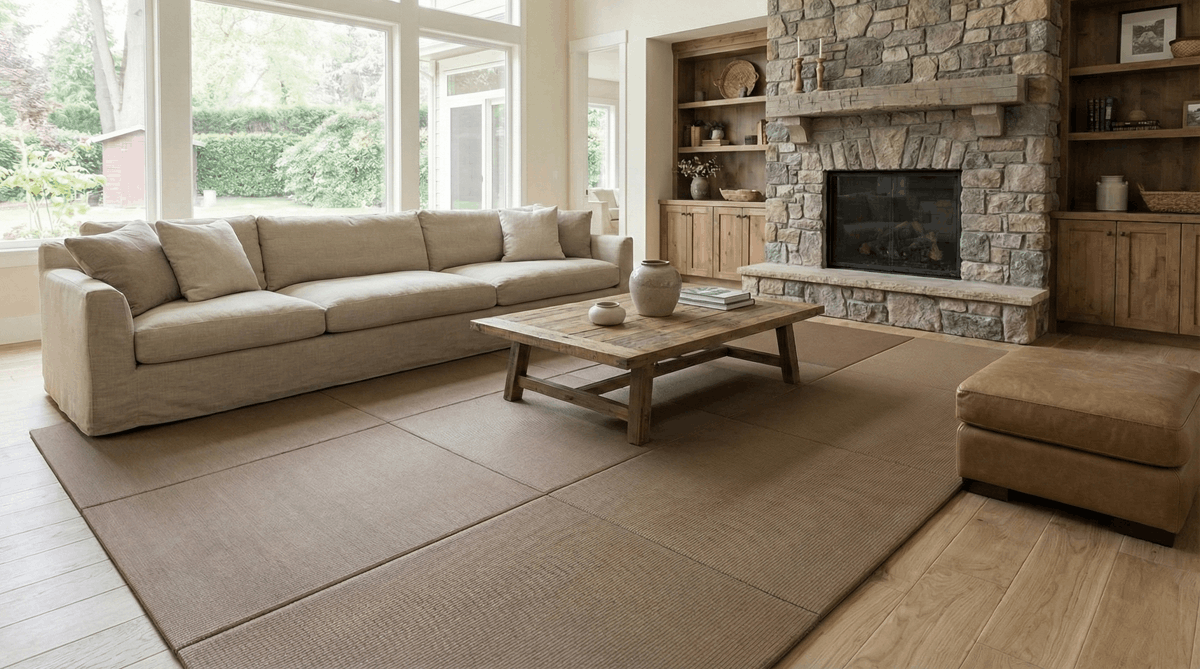
Earth tones are having a moment in early 2026, with chocolate brown described as a warmer, richer “new neutral,” tied to nature-inspired palettes and natural materials.
In Japan, a 2026 trend roundup also emphasizes warm, grounded palettes like olive green, sand beige, and browns.
Tatami plays well here because it lives in the same family of calming, nature-based color logic—especially when you choose a modern surface color (not only traditional green).
Keep it modern: balancing ‘organic’ with clean lines
If you love the organic look but fear “rustic overload,” keep two rules:
- One main texture (tatami) + one secondary texture (linen or wool).
- Clean-lined containers to help organize clutter.
This is also where “slow design” thinking becomes a practical filter: buy fewer things but choose pieces with craft and longevity.
2026 Trend Pairing #3: Wellness-First Interiors + Tatami (Meditation, Stretching, Reading)
Light and rhythm: a wellness approach that complements tatami living
Wellness features are getting more sophisticated than “just add a candle.” Architectural Digest highlights circadian lighting—lighting that changes through the day to align interiors with natural rhythms—as part of designing homes that restore.
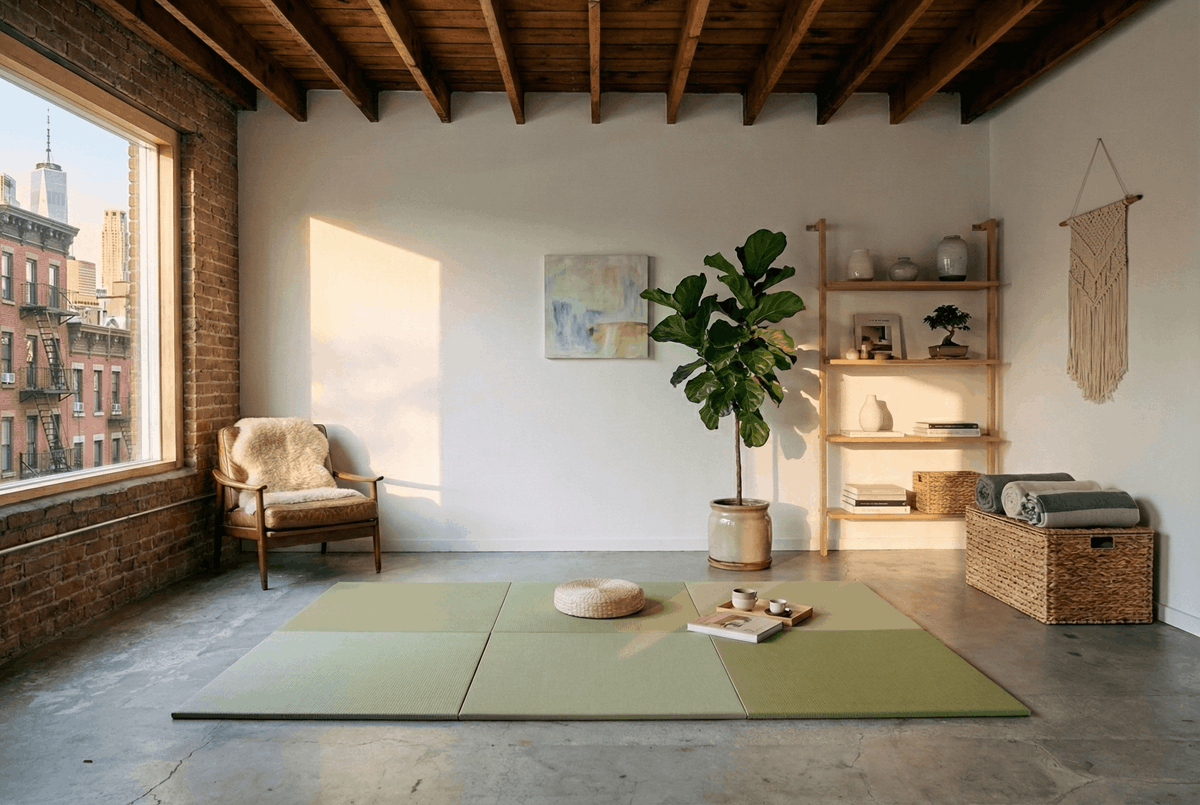
Tatami pairs naturally with wellness-first design because it supports floor-based routines: meditation, mobility work, gentle stretching, breathwork, or simply sitting lower to the ground.
A simple ‘Zen zone’ layout that works in U.S. apartments
Even small spaces can do this:
- Put tatami in a 1–4 tile rectangle near natural light.
- Keep the wall mostly empty (one art piece max).
- Add a low table (or tray) and one cushion.
- Use a basket for quick “reset” container.
This creates an intentional, calming micro-room without needing a dedicated spare bedroom.
2026 Trend Pairing #4: Slow Design, Craft, and Materials With a Story + Tatami
Why craftsmanship and provenance matter more now
Slow design” is gaining attention as a response to mass production, as more people seek spaces that feel personal and emotionally meaningful.
Tatami is inherently story-rich: it’s traditional Japanese flooring, and Japan’s own official cultural content notes that people still value tatami’s look and feel and incorporate it into modern interiors.
Avoiding the ‘theme room’: subtle Japanese cues that feel elevated
To keep tatami modern in a U.S. home:
- Instead of explicit motifs, allow the tactile presence of materials like wood, paper, and ceramics to take center stage.
- Use negative space (one display object, not ten).
- Keep furniture low-profile and simple.
This is also consistent with Japandi guidance from Japanese sources emphasizing natural materials and “blank space” as an intentional design choice.
U.S. vs Japan: The Cultural Difference That Makes Tatami So Versatile
The washitsu mindset: one room, many uses
A key cultural contrast: U.S. homes traditionally assign a dedicated purpose to each room, while the Japanese washitsu approach is built around flexibility. One clear explanation describes washitsu as “an open room…[with] no dedicated purpose,” where use is defined by the occupants.
This is exactly why tatami works so well for modern lifestyles: it supports a space that can shift from yoga → reading → guests → play.
How to adopt that flexibility in a U.S. home with modular tatami
- Daytime: open floor space for movement or play.
- Evening: add a low table for tea, journaling, or board games.
- Guest mode: clear the low table; use the tatami zone as a calm landing area.
This approach also aligns with the U.S. trend toward homes that “support real life” and practical adaptation.
Choosing a Tatami Mat for a Modern U.S. Home
What to look for: performance, maintenance, and material choice
If you’re placing tatami in a high-use U.S. living space, performance matters. Our tatami surfaces use Japanese woven paper and highlights resistance to issues like ticks, mold, water, and abrasion.
Additionally, anti-mold performance testing showed that our tatami-facing products are less prone to mold growth than standard rush-based tatami.
Practical takeaway: if you want the tatami feeling with easier maintenance, consider modern, performance-oriented surfaces like ours.
When to buy vs when to inquire (custom sizing, samples, design support)
Buy (unit tatami) if:
- You want a fast, modular way to try tatami in a Western-style room.
- You prefer a “define-a-zone” approach (wellness corner, reading nook, play area).
Inquire (contact/quote) if:
- You need custom sizing or project support.
- You want to share drawings for a tailored fit—We explicitly requests a drawing attachment for quotations.
We also offer sample tiles availability for selection so that you can check the actual feel of the surface.
Summary: Your 2026 tatami-ready trend checklist
If you want to align with 2026 U.S. interior design trends while bringing in Japanese calm, here’s the simplest checklist:
- Choose warmth over stark minimalism (Focus on texture + soft light). (Better Homes & Gardens)
- Embrace lived-in comfort (rooms made for real life). (Vogue)
- Use earthy neutrals and natural materials for a grounded palette. (Better Homes & Gardens)
- Build a wellness corner (even in small spaces) and reduce visual noise. (Architectural Digest)
- Make it flexible: a tatami zone that can change purpose over the day. (Tofugu)
If you’re ready to try it, start with Interra USA’s unit-style tatami mats to create a modular tatami zone in any room. If you’re planning a larger project (or want help selecting the right configuration), use Interra USA’s contact/quote path to request guidance and sizing support.
Reference link:
25 Home Design Trends Defining How We’ll Live in 2026
The 11 Key Interior Design Trends Set to Define 2026
The 2025 Interior Design Trends That Are Here to Stay—And the Ones on Their Way Out
This Winter Decorating Trend Will Make You Never Want to Leave the House (Cozymaxxing)
Why Chocolate Brown Is the New Neutral Everyone Wants Right Now
The Evolution of Tatami (Web Japan / Ministry of Foreign Affairs of Japan)
Tatami | Nippon.com
Washitsu: A Japanese Room for Guests, Family, or Alone Time
Japandi(ジャパンディ)とは?|馴染むインテリアの特徴とおしゃれな取り入れ方
〖2026年最新〗流行のインテリアトレンドは?注目のスタイル・キーワードをご紹介